
Community profile · South Sudan and Ethiopia
Anywaa / Anuak
Anywaa · Anuak (spellings vary)
Anywaa communities live across the South Sudan–Ethiopia border region. This profile recognises cross-border connections and the importance of local self-identification.
Introductory profile · Cross-border review invitedFrom the original KP Jaluo Abroad heritage book
Community history
and cultural account.
Watch and explore
Videos and documentaries
People and Identity
The Anuak—also spelled Anywaa, Anyuaak, or Anyuak—are a Luo ethnic group found in parts of East Africa, primarily in western Ethiopia and eastern South Sudan. As members of the Luo family, the Anuak are linguistically and culturally connected to other Nilotic groups such as the Shilluk.
They speak Dho-Anywaa, a Nilotic language within the Nilo-Saharan family, and are estimated to number between 200,000 and 300,000 people worldwide. The Anuak are predominantly Christian, and, alongside the Shilluk, were among the first Nilotic groups to embrace Christianity almost entirely.
Mythology and Historical Origins
The Anuak possess a unique mythological origin story that sets them apart from their Luo cousins. According to tradition, Anuak women fetching water encountered a mysterious river-dweller named Ocwudho, a silent figure who carried a kaak (fishing spear) and vanished into the river to avoid contact. Eventually captured and brought to the village, he refused to speak, eat, or drink—until Akango sent his younger daughter to take care of him. She fed him and gave him water.
Ocwudho eventually formed a bond with the girl, and she became pregnant. Upon discovering this, Ocwudho disappeared into the river, leaving behind ceremonial beads (ocwak, nyalo, garmuto, ganga) for the girl’s father. The child born from this union was Gilo, revered as the great ancestor and founder of the Anywaa nation.
To this day, Anuak royal symbolism draws from this myth. When the Anywaa Nyie (King) passed, it was said that he "returned to the river" like Ocwudho.
Historically, the Anuak lived along the Pibor and Sobat Rivers in what is now eastern South Sudan. However, due to displacement pressures from neighboring groups, the majority of Anuak have since relocated to areas along the Baro River and the Akobo River, particularly within Ethiopia’s Gambela Region.
Language
The Anuak speak Dho-Anywaa, a Nilotic language that is closely related to Dho-Luo of Bahr el Ghazal, Dhi-Chollo (Shilluk), and Dhi-Pari. These languages share high mutual intelligibility, reflecting the shared origin of these Southern Luo communities. Dho-Anywaa is primarily spoken in western Ethiopia and is an essential marker of Anuak identity, culture, and oral tradition.
Homeland and Geography
The Anuak live predominantly in the Gambela Region of Ethiopia, along the Baro and Akobo Rivers, as well as in parts of South Sudan. Their traditional homeland is defined by its grassy, flood-prone plains, which transform into seasonal swamplands during the rains. These conditions shape their riverine lifestyle, heavily based on fishing, farming, and small-scale herding.
Diaspora and Displacement
Following the collapse of the People’s Democratic Republic of Ethiopia in 1991, the Anuak experienced widespread inter-ethnic violence, particularly in the 1990s and early 2000s. These conflicts led to mass displacements, persecution, and human rights violations—prompting thousands of Anuak to flee the country.
Many resettled abroad, with a significant number relocating to the United States, especially in Minnesota. Some received relocation assistance from the International Organization for Migration (IOM). In Minnesota, the Anuak diaspora has established strong community networks, with many working in industries such as meatpacking, for companies like Hormel Foods and Smithfield Foods.
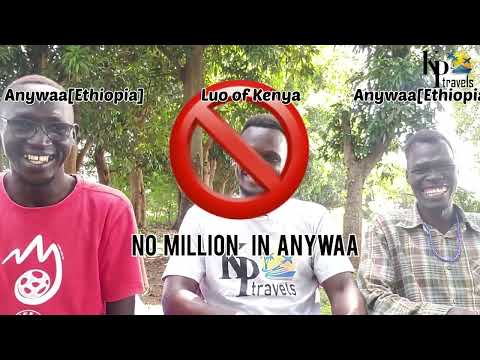
📺 Watch Full Language comparison on Anywaa vs Joluo of Kenya & Tanzania
Watch related video on YouTube ↗Finished reading?
Watch the story
Identity and naming
Recognising the community
on its own terms.
Anywaa and Anuak appear in different contexts. Contributors should state the form preferred by the community and locality being discussed.
KP Jaluo Abroad extends sincere gratitude to the elders, cultural custodians, storytellers, researchers, families and community members whose knowledge, memories and contributions have helped bring the story of Anywaa / Anuak to light. Your willingness to share and document this heritage helps preserve it for present and future generations. We appreciate everyone who has walked alongside KP Jaluo Abroad in making this community story visible.
Areas of heritage documentation
Anywaa language and oral traditions
Cross-border community and family histories
Riverine environments, place memory and livelihoods
Cultural practices and contemporary diaspora life
Related directory


